Biophotonic Sensing Group
Lund University
Recent Publications
Emmanuel Kotu Robertson, Meng Li, Hampus Månefjord, Jadranka Rota, Nina Reistad & Mikkel Brydegaard 10.1109/JPHOT.2025.3628525
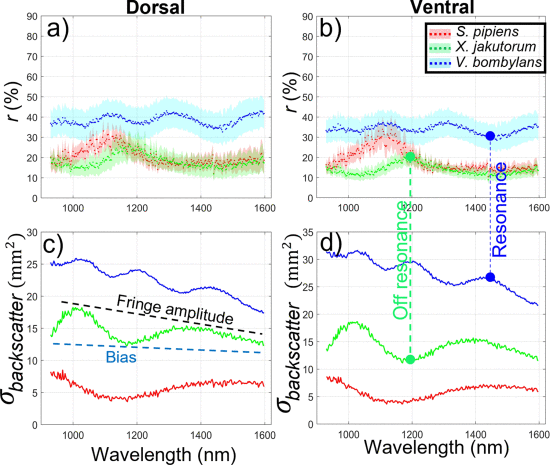
Goniometric Investigation of Spectral Scattering From Insect Wings in Near Infrared
This study explores how insect wing interference, which is highly sensitive to membrane thickness, can be used to differentiate species both in the lab and in the wild. While previous research has noted the diversity of wing interference patterns, this report is the first to link resonant coherent scattering from membranes to the goniometric scattering phase function. By combining spectral and goniometric analysis, the researchers demonstrate that resonant wavelengths interact specifically with thin, flat wing membranes, while dissonant wavelengths primarily scatter from tubular veins. This work establishes a foundation for better understanding range dependence in entomological Lidar and improving insect identification through spectral and modulation properties.
Assoumou S. Doria Yamoa, Benoit K. Kouakou, Adolphe Y. Gbogbo, Anna Runemark, Roel van Klink, Jeremie T. Zoueu & Mikkel Brydegaard 10.1038/s41598-025-27432-9
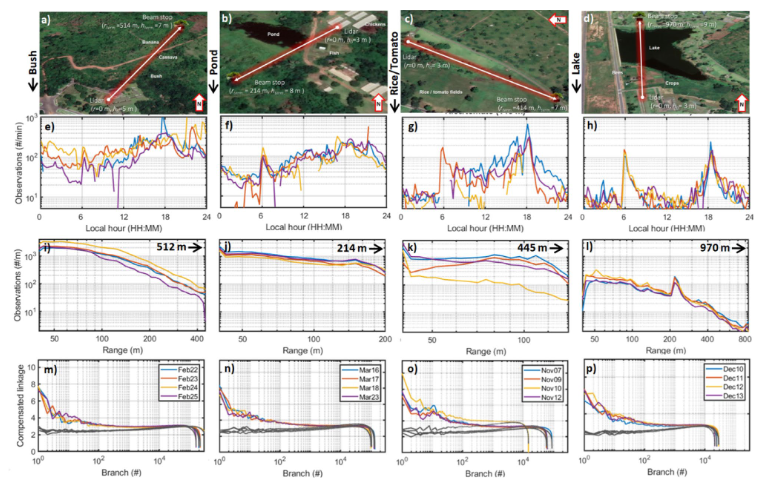
Lidar reveals distinct insect daily activity and diversity between habitats
This study demonstrates how entomological Lidar provides a rapid, non-intrusive assessment of insect abundance, diversity, and composition across different habitat types. By analyzing over 1.7 million observations—the largest dataset of its kind reported to date—the research highlights consistent differences in insect activity, range distributions, and daily patterns between four distinct sites. The study introduces a robust, parameter-free method for estimating signal diversity and discusses the future challenges for physicists and ecologists using Lidar for biodiversity monitoring.
Hampus Månefjord, Assoumou Saint-Doria Yamoa, Yatana Adolphe Gbogbo, Lauro Müller, Anna Runemark, Benoit Kouassi Kouakou, Rabbi Boateng, Andrew Atiogbe Huzortey, Isaac Kwame Badu, Niklas Wahlberg, Mikkel Brydegaard, Jérémie T. Zoueu, Benjamin Anderson & Meng Li
10.1038/s41598-025-05200-z
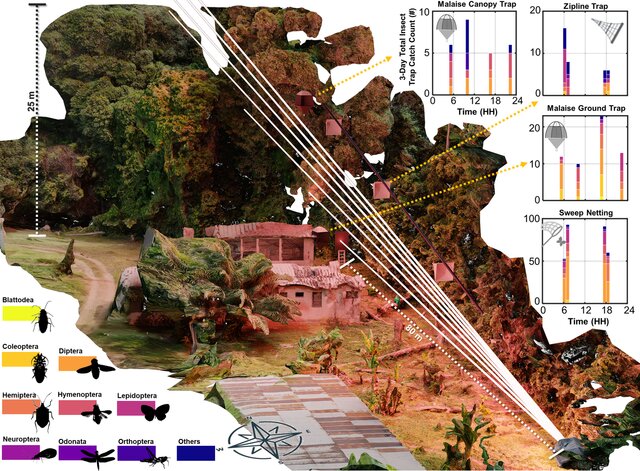
Stratification of insect diversity and daily activity patterns in the West African virgin forest Taï assessed by entomological Lidar
This study used Lidar technology, alongside traditional trapping, to non-destructively explore insect diversity within the canopy of the Taï virgin forest in Côte d’Ivoire. The research found stratified patterns of insect activity, with Lidar signals revealing that different insect communities were active at different heights and times of the day. By correlating these signals with the optical properties of captured insects, the study shows that Lidar is a promising tool for continuously and non-invasively assessing insect biodiversity in complex ecosystems.
Meng Li , Hampus Månefjord , Julio Hernandez, Lauro Müller, Christian Brackmann , Aboma Merdasa, Carsten Kirkeby, Mengistu Dawit Bulo, Rickard Ignell and Mikkel Brydegaard
10.1177/00037028251341317
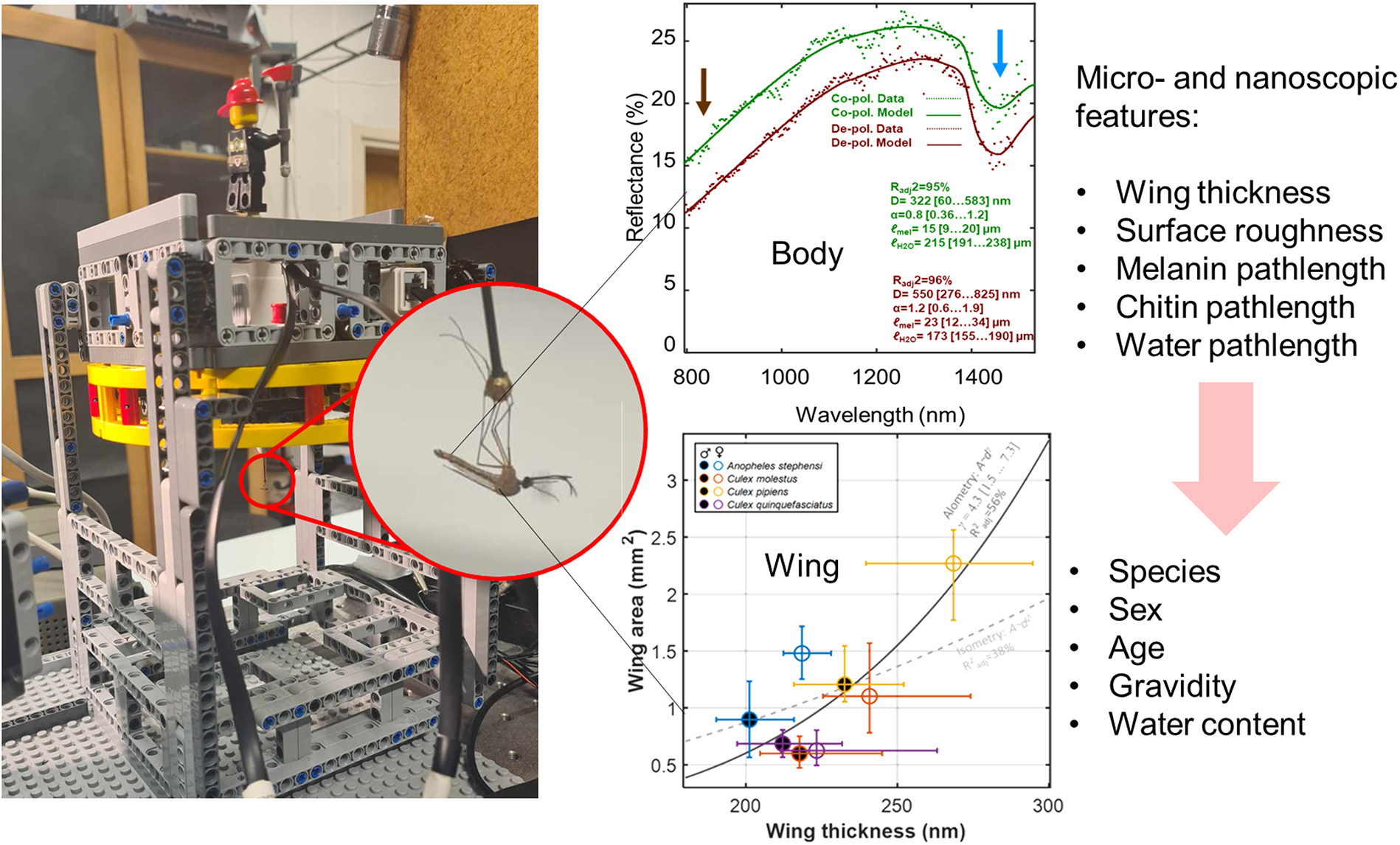
Deadliest Animals with the Thinnest Wings: Near-Infrared Properties of Tropical Mosquitoes
To better monitor mosquitoes that transmit diseases like malaria and Zika, this study developed a spectral reflectance model for remote classification. Using hyperspectral imaging on mosquitoes of different species, sexes, ages, and gravidity states, we determined key parameters like wing thickness (a record-thin 174 nm), melanin, and water pathlengths with high accuracy. Crucially, we found that a mosquito’s orientation has a minimal effect on its shortwave infrared spectra. These results show the potential for spectral sensors and lidars to remotely retrieve micro- and nanoscopic mosquito features, leading to more specific vector monitoring.
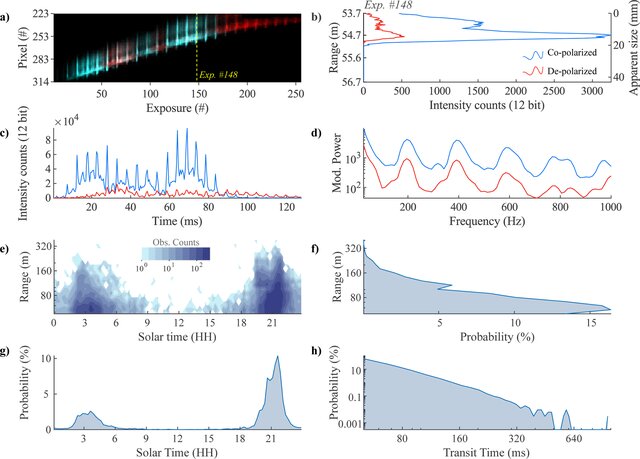
Dolores Bernenko, Meng Li, Hampus Månefjord, Samuel Jansson, Anna Runemark, Carsten Kirkeby, Mikkel Brydegaard. 10.1371/journal.pone.0312770
Insect diversity estimation in polarimetric lidar
Entomological lidar enables rapid, non-intrusive insect identification in the field. This study reports 32,533 insect observations along a 500-meter transect and evaluates the role of polarimetric lidar bands in species differentiation. While lidar distinguishes about a hundred signal types, species richness often exceeds tens of thousands. Comparing Hierarchical Cluster Analysis and Gaussian Mixture Model, we find that polarization offers only minor improvements. Using flight characteristics such as wingbeat frequency and activity patterns, we estimate a lower bound for species diversity.
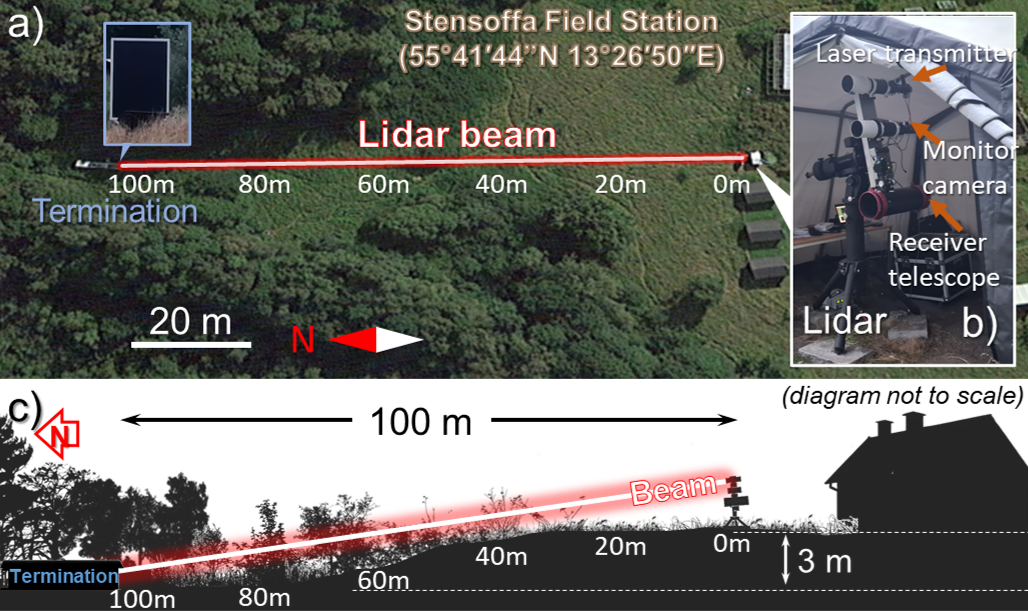
Meng Li, Hampus Månefjord, Mikkel Brydegaard.10.1109/IPC60965.2024.10799610
Resolving fast wingbeat flashes in situ with entomological lidar
Specular wing flashes provide key data for remote insect assessments, but their limits remain unclear. Using a 40 kHz entomological lidar, we resolved flashes as short as 130 μs from 40 meters. Higher sampling rates improved wing thickness accuracy and reduced artifacts like beating and folding. Our results highlight the potential of high-speed lidar for species differentiation and insect flight analysis.
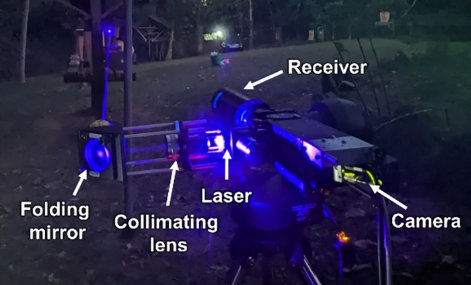
Hampus Månefjord, A. Andrew Huzortey, Rabbi Boateng, Y. Adolphe Gbogbo, A. S. Doria Yamoa, Jérémie T. Zoueu, Peter K. Kwapong, Benjamin Anderson, Mikkel Brydegaard. 10.1186/s40317-024-00372-3
Hyperspectral lidar for monitoring high-resolution activity patterns of African stingless bee species
Stingless bees are crucial pollinators and honey producers in the tropics, but research on them, especially species endemic to Sub-Saharan Africa, is lacking compared to western honeybees. Traditional methods for studying their behavior have limitations. This study proposes using fluorescent powder tagging and hyperspectral fluorescence lidar to monitor stingless bees, potentially providing a more effective way to understand their behavior.
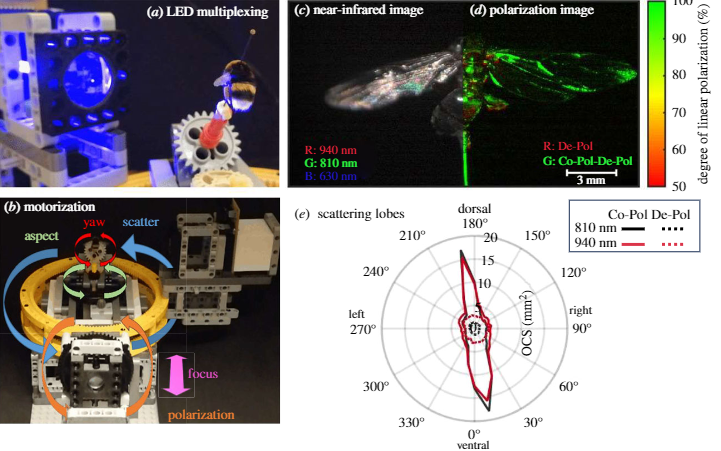
Mikkel Brydegaard, Ronniel D. Pedales, Vivian Feng, Assoumou Saint-Doria Yamoa, Benoit Kouakou, Hampus Månefjord, Lorenz Wührl, Christian Pylatiuk, Dalton de Souza Amorim, Rudolf Meier. 10.1098/rstb.2023.0103
Towards global insect biomonitoring with frugal methods
This paper highlights the urgent need for accessible insect biomonitoring methods, particularly in underfunded regions with high biodiversity. It advocates making current techniques more affordable and emphasizes evaluating their global suitability before widespread adoption. The authors propose prioritizing low-cost data acquisition methods, like computer vision and lidar, and utilizing AI for analysis to ensure broader accessibility. Additionally, they stress the need for a global strategy to support the computational resources and training required for AI-driven data analysis in biodiversity conservation.
Hui Chen, Meng Li, Hampus Månefjord, Paul Travers, Jacobo Salvador, Lauro Müller, David Dreyer, Jamie Alison, Toke T. Høye, Gao Hu, Eric Warrant, Mikkel Brydegaard. 10.1016/j.isci.2024.109588
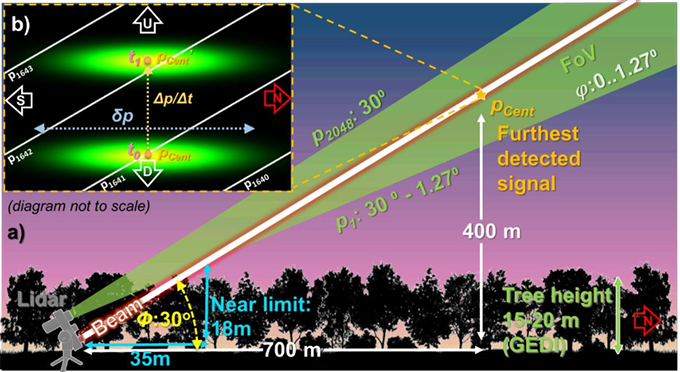
Lidar as a potential tool for monitoring migratory insects
This study demonstrates the use of lidar technology to illuminate the previously unknown low-altitude migratory behaviors of insects, particularly moths, in southern Sweden. A novel method for distinguishing moths from other insects was developed, offering valuable insights into their migration patterns and potentially informing pest control strategies.
Klas Rydhmer, Samuel Jansson, Laurence Still, Brittany D. Beck, Vasileia Chatzaki, Karen Olsen, Bennett Van Hoff, Christoffer Grønne, Jakob Klinge Meier, Marta Montoro, Inger Kappel Schmidt, Carsten Kirkeby, Henrik G. Smith, Mikkel Brydegaard. 10.1016/j.ecolind.2023.111483
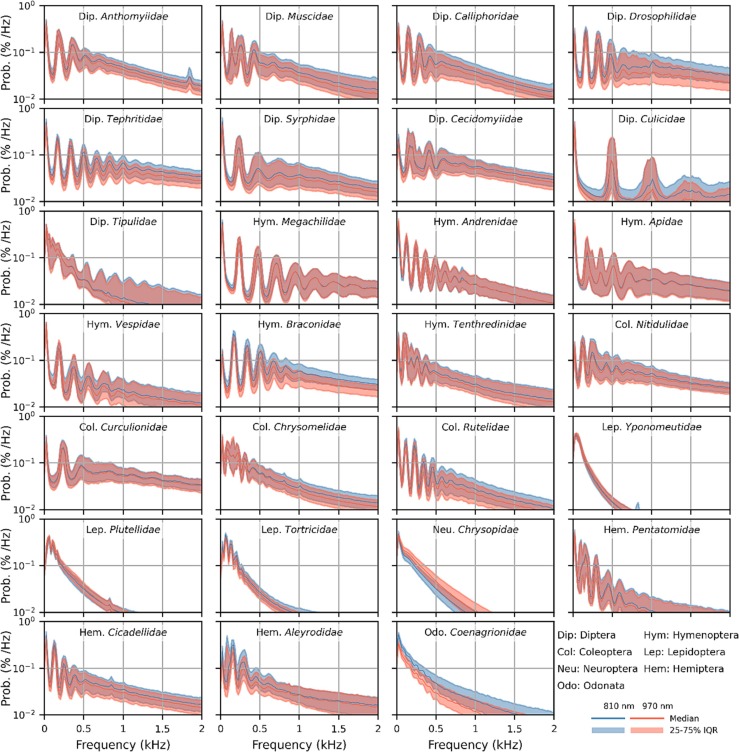
Photonic sensors reflect variation in insect abundance and diversity across habitats
This study shows that photonic sensors have the potential to revolutionize insect biodiversity monitoring, offering a more efficient and accurate alternative to traditional methods. By comparing results with established techniques, the study demonstrates the effectiveness of photonic sensors in quantifying insect species richness, paving the way for broader and more comprehensive studies of insect populations.
Full Publications (Up to date):
https://portal.research.lu.se/en/persons/mikkel-brydegaard
PhD Thesis
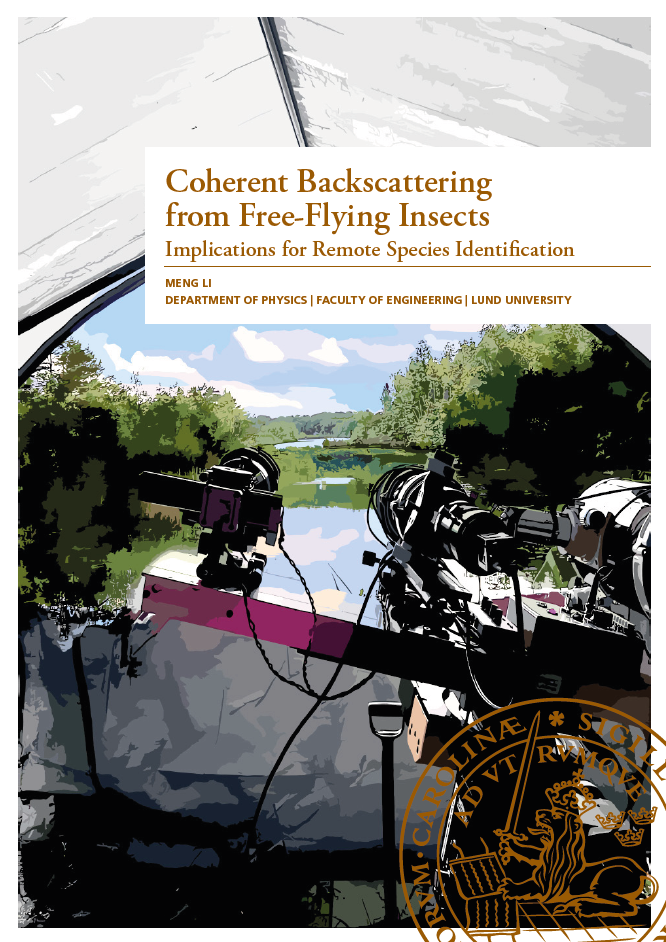
Coherent Backscattering from Free-Flying Insects: Implications for Remote Species Identification
Meng Li| Division Of Combustion Physics | Department Of Physics | Lund University | 2024
The decline in insect populations necessitates better monitoring tools. Conventional methods are labor-intensive and lack real-time data. Remote sensing offers a solution, but current techniques have limitations in species differentiation. To address this, entomological lidar has been developed, utilizing the Scheimpflug principle. This research investigates how insect optical properties can enhance their identification through lidar. It explores wing reflectance, interference patterns, surface roughness, and polarimetry. Methodologies like dual-band and hyperspectral lidar are also being investigated. Entomological lidar, with photonic techniques, can transform insect monitoring, improving pest control, biodiversity studies, and our understanding of these vital creatures.
Toward Accessible Biophotonics: Instrumentation for Insect and Vegetation Applications
Hampus Månefjord | Division Of Combustion Physics | Department Of Physics | Lund University | 2024
This thesis focuses on the development and implementation of accessible biophotonic instruments for insect and vegetation studies. These include a novel six-dimensional camera that captures spatial, spectral, polarimetric, and goniometric information. This instrument analyzed malaria and Zika mosquito species, sex, age, and gravidity. Additionally, two hyperspectral lidars were created – one for fluorescence, enabling studies of chlorophyll response and monitoring tagged insects (e.g., stingless bees), and the other for elastic light, used for the first-ever remote wing thickness measurements of flying insects. Both lidars are unique in featuring 70 spectral bands.

Insects in the spotlight
photonic monitoring of bees and insect biodiversity
Klas Rydhmer | Department of Geosciences and Natural Resource Management | University of Copenhagen | 2023
This thesis presents a spatial model for honeybee monitoring using conventional entomological lidar, demonstrating good agreement with manual observations. It details the development of the new “Volito” sensor and correlates measured insect abundance with yellow water traps. The thesis explores a deep learning approach to feature extraction from recorded data, improving upon earlier models from the literature. Finally, it includes two draft manuscripts. The first attempts to correlate a sensor-based diversity metric with conventional monitoring methods in agricultural fields in Iowa, USA. The second focuses on protected areas in southern Scandinavia.

Entomological Lidar
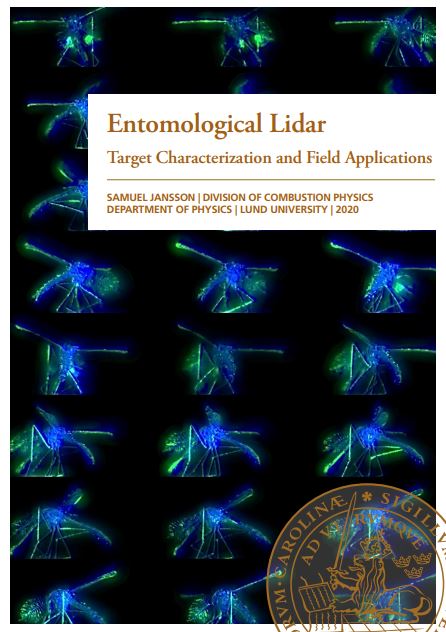
Target Characterization and Field Applications
Samuel Jansson | Division Of Combustion Physics | Department Of Physics | Lund University | 2020
In this thesis work, peak numbers of more than a thousand insects per minute have been observed, resolved temporally and spatially at μs and cm scales, respectively, which is inconceivable with conventional entomological methods. Laboratory reference work and methodological development allow the quantification and classification of insect signals in-situ. Thereby, questions of significant ecological importance could be answered.
From Fauna to Flames Remote Sensing with Scheimpflug-Lidar
Elin Malmqvist | Faculty Of Engineering | Department Of Physics | Lund University | 2019
This thesis presents applications of the Scheimpflug Lidar (S-Lidar) method. The technique has been applied to combustion diagnostics on a scale of several meters as well as fauna detection and monitoring over distances of kilometers. Lidar or laser radar is a remote sensing technique where backscattering of laser light is detected with range resolution along the direction of the laser beam. It is an established method in e.g. atmospheric sensing where it is used to map and monitor gases and aerosols. In contrast to conventional Lidar, which uses a time-of-flight approach, Scheimpflug Lidar uses imaging to achieve range resolution. The laser beam transmitted from the Lidar system is sharply imaged onto a detector, resulting in range resolution along the sensor

Master Thesis

Goniometric investigation of scattering from
insect wings in near infrared
Emmanuel Kotu Robertson
(2024)
Combustion Physics
Department of Physics
Spectrally resolved insect flashes by sunlight
Hendriks, Isabel
(2023)
Combustion Physics
Department of Physics
Elastic hyperspectral lidar for detecting coherent backscatter from insects
Müller, Lauro
(2022) PHYM03 20221
Combustion Physics
Department of Physics
Insect Diversity Estimation in Entomological Lidar
Xu, Zhicheng
(2022) BINP52 20212
Degree Projects in Bioinformatics

Method for coupling modulatedscattered light from free flyinginsects to harmonics and theirrelative phases
Patricks, Martin and Anderberg, Ludvig
(2020) PHYM01 20192
Combustion Physics
Department of Physics
Mathematical Statistics
Implementation of Scheimpflug Lidar for Entomological Monitoring of Bark Beetles
Peterson, Jonathan
(2020) FYSM30 20191
Department of Physics
Combustion Physics
Unbiasing entomological kHz Scheimpflug LIDAR data
Andersson, Alexandra
(2018) FYSM60 20172
Department of Physics
Combustion Physics
Short-Wave Infrared Lidar on Atmospheric Aerosols and Insects
Andersson, Mariam
(2017) FYSM60 20171
Department of Physics
Combustion Physics


Applied hyperspectral LIDAR for monitoring fauna dispersal in aquatic environments
Rydhmer, Klas and Strand, Alfred
(2016) PHYM01 20161
Combustion Physics
Department of Physics
Inelastic LIDAR for Monitoring Aquatic Fauna
Ljungholm, Mikael
(2016) PHYM01 20151
Combustion Physics
Department of Physics
Kilohertz electro-optics for remote sensing of insect dispersal
Török, Sandra
(2013) PHYM01 20131
Department of Physics
 Biophotonic Sensing Group